
Enterprise-level private cloud construction and hybrid cloud management solutions
Based on Microsoft hybrid cloud platform, providing enterprises withLocal private cloud construction and hybrid cloud management solutions, achieve an application platform and management experience consistent with public cloud, and meet data localization and compliance requirements.
Azure Stack Hub
Bring the agility of cloud computing to on-premises environments, delivering Azure-consistent cloud services in the data center, supporting fully connected or disconnected autonomous cloud operating models.
Azure Stack HCI (Azure Local)
The enterprise-class hyper-converged infrastructure platform integrates computing, storage and network, and builds a high-performance modern private cloud through Azure management automation.
Azure Stack Edge
Azure-managed edge hardware-as-a-service devices extend Azure computing, storage, and AI capabilities to the edge locations where data is generated, and are managed uniformly in the cloud.
Core challenges facing businesses
The contradiction between the architectural limitations of traditional data centers and growing business needs is accelerating enterprises' urgent need for hybrid cloud architecture.
Low resource utilization
Average server utilization in traditional data centers is insufficient20%, a large amount of physical hardware is idle or under low load, and operating expenses such as power and cooling continue to consume the budget.
Long lead time
IT resource applications must go through review, procurement, shelving, configuration, etc. The average requirement from request to environment readiness is6-12 weeks, unable to respond to rapid business changes.
Lack of cloud native support
Existing infrastructure cannot run Kubernetes and containerized workloads, hindering microservice transformation andDevOpsThe process is implemented.
Data compliance constraints
Class insurance, insurance in finance, government, medical, manufacturing and other industriesGDPRRegulatory laws and regulations require sensitive data not to leave the country and be stored locally, so it cannot be directly uploaded to the cloud.
Multi-cloud management fragmentation
Local data centers, public clouds and edge nodes work independently, with inconsistent strategies and scattered monitoring, requiring operation and maintenance teams to switch.3+ consoles。
Security threats escalate
Hybrid architecture expands the attack surface, new threats such as ransomware and supply chain attacks occur frequently, and traditional security tools have limited coverage capabilities.Detection response is severely delayed。
Nine core competency modules
Based on Microsoft's hybrid cloud product matrix, it covers full-stack solution capabilities from infrastructure and application modernization to security and compliance.
Private cloud infrastructure platform
based onAzure Stack HCIBuild an enterprise-level hyper-converged private cloud, deeply integrate computing, storage, and network, and quickly deliver a production-ready environment through the hardware partner certification system.
Hybrid cloud unified management
passAzure ArcIncorporate local, multi-cloud and edge resources into the Azure management and control plane to manage all infrastructure and application services from a single console.
Cloud native application platform
run locallyAzure Kubernetes Service, using container orchestration capabilities consistent with public clouds to support modern application development of microservices and serverless architectures.
Edge and offline operations
passAzure Stack HubRun autonomous clouds in disconnected or network-constrained environments to meet special scenarios with edge computing and data sovereignty requirements.
Data and application services
Stretch across hybrid cloud environmentsAzure PaaSAbility to deploy database hosting, application hosting and AI inference services to local data centers or edges.
Application modernization and DevOps
With Azure-alignedDevOps process, update and extend existing business applications using containers, serverless and microservices architectures in hybrid environments.
Disaster preparedness and business continuity
useAzure Site RecoveryandAzure BackupBuild a multi-level disaster recovery system to achieve automated failover across data centers and clouds.
Security and Compliance
integratedMicrosoft Defender for CloudandEntra ID, build an enterprise-level in-depth security system covering identity, network, host and data.
Cost Governance and FinOps
Building a hybrid cloud environmentFinOpsGovernance system, using Azure hybrid rights and resource optimization strategies to achieve transparent control and continuous optimization of cloud costs.
🏗Azure Local hyperconverged reference architecture
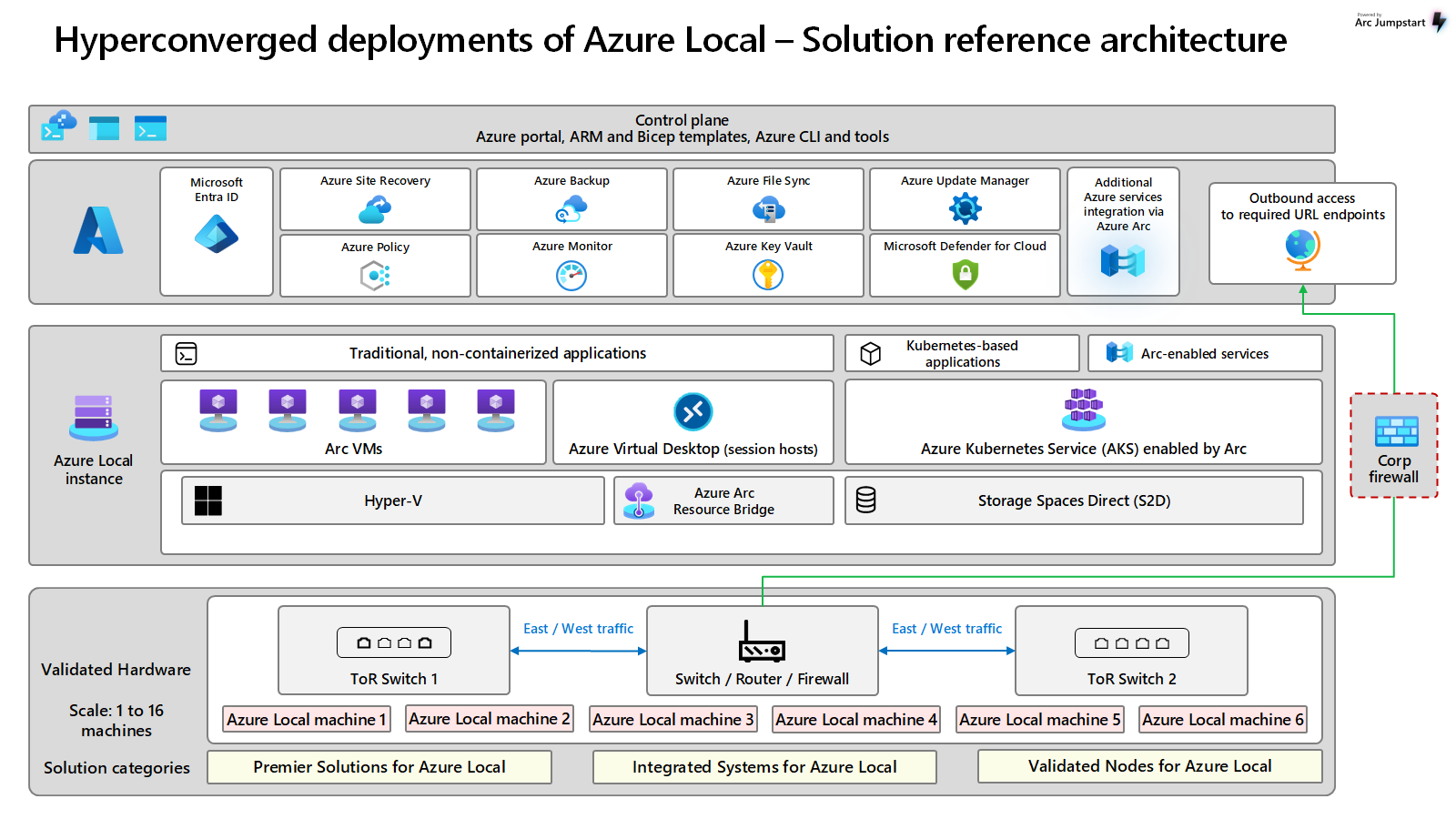
Image source: Microsoft Learn - Azure Local hyperconverged solution reference architecture
Azure cloud service layer
Integrate local clusters into the Azure management and control plane through Azure Arc, and use Azure Portal for resource management, monitoring alarms, and policy governance.
Azure Local cluster
A hyperconverged cluster composed of multiple proven server nodes provides a pool of local computing, storage and network resources to support VM and container workloads.
Virtual machines and containers
Run Windows/Linux VMs and AKS hybrid container workloads on the cluster, supporting parallel deployment of traditional and cloud-native applications.
Storage Spaces Direct
The software-defined storage engine aggregates the local disks of each node in the cluster into a high-availability storage pool, providing mirror redundancy and automatic tiering capabilities.
SDN network virtualization
Implement virtual switching, load balancing and network security policies through software-defined networking, supporting tenant isolation and hybrid connections.
Security and Management
Integrate Windows Admin Center and Azure security services to provide cluster deployment wizards, health monitoring, firmware updates and security baseline management.
Five-stage standardization implementation methodology
From planning and design to operation and maintenance optimization, it covers the five core stages of the entire life cycle of hybrid cloud construction.
Planning and Design
Typical application scenarios
For different industries and business needs, the Azure Stack hybrid cloud solution covers four core scenarios.
It meets the data sovereignty and compliance requirements of the financial, government, and manufacturing industries, and sensitive data does not leave the local data center.
Deploy applications in edge environments such as factories, stores, and branches to achieve low-latency data processing and real-time decision-making.
Some services are run locally, and some are elastically expanded on the Azure public cloud. Both ends collaborate to achieve optimal resource utilization.
Use Azure as a disaster recovery center to achieve automated failover and business continuity assurance from local to cloud.
Quantifiable customer value
Improved IT resource delivery efficiency50%
Through resource pooling and automated deployment, the IT resource delivery cycle is shortened from weeks to hours to quickly respond to business needs.
Reduced IT operation and maintenance costs30%
The unified management plane and automated operation and maintenance reduce manual intervention, and combine with resource optimization strategies to effectively control the total cost of ownership.
Business system availability99.9%
Ensure high-availability operation of core business systems throughout the year through cross-data center disaster recovery, automatic failover and continuous monitoring.
Our service capabilities
Relying on its profound Microsoft technology foundation, it provides a full range of hybrid cloud services from consulting planning to operation and maintenance hosting.
Deeply understand business needs and tailor private cloud architecture solutions and capacity planning recommendations.
End-to-end delivery of installation, configuration and acceptance of Azure Stack Hub / HCI platform to ensure production readiness.
Design a hybrid cloud architecture that connects local and Azure to achieve network interconnection, identity unification, and data circulation.
Provide professional operation and maintenance services with 7x24 monitoring, fault response, patch management and continuous optimization.
Ready to build your hybrid cloud platform?
Get customized consulting services from an expert team to design an integrated implementation plan for Azure Stack private cloud construction, hybrid cloud architecture, and operation and maintenance management for your enterprise.